

Design parameters that affect MCM pricing
June 15, 2009
Many designers would like to know what makes some aluminum composite material panel projects cost $40 per SF while others can be $25 per SF. Listen up everyone; I am going to share that with you.
The following design parameters will determine the price:
- Quantity of panels
- Modules for the panels
- Panel sizes
- Color
- Geometric complexity
- Attachment system
- Installation
Quantity
The price for the Metal Composite Material sheets varies significantly by quantity. If the quantity of material decreases from 10,000 SF to 300 SF, the cost of the sheets will increase by 100%. Or, if the quantity increases from 300 SF to 10,000 SF, then the cost decreases by 50%.
Modules
MCM is available as a standard in 50” and 62” wide sheets. To get the best use of the material, panels should be designed around a 48” or 60” panel width dimension. The required widths of panels can affect the “yield” on the ACM tremendously. Normal “drop” is about 20%, but some projects could have 50% “drop” if an inefficient module is chosen. This could increase the ACM cost by 30%.
Panel Sizes
It takes a similar amount of time to produce small or large size panels. 1,000 SF of panels at 20 SF/panel would cost 250% more shop labor to produce than 1,000 SF of panels at 50 SF/panel. Also, the amount of attachment accessories could be 50% more costly.
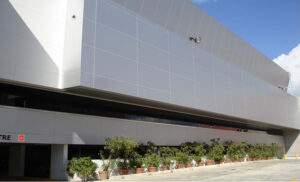
For example:
1,000 SF of panels could be produced in either 250 panels that are 2’-0” X 2’-0” or 50 panels that are 4’-0” X 5’-0”or 20 panels that are 5’-0” X 10’-0”. So, if it takes $50 of Shop Labor to fabricate a panel; the cost for 1,000 SF of panels can range from $12,500 to $2,500 to $1,000. That is a heck of a spread for one element of the entire project and it is a decision that can be “controlled” in many cases through design decisions.
Color
Vivid color is a highly desirable attribute of MCM. MCM is normally painted in a roll coater because this is the most economical method for large quantities of material. However, it is not an efficient method to paint small quantities of material. Therefore, for economy, standard colors should be chosen for small quantities.

Geometric Complexity
MCM panels offer a great deal of design flexibility because they can be formed into a wide variety of geometric shapes. Each shape type has an associated cost impact. For example:
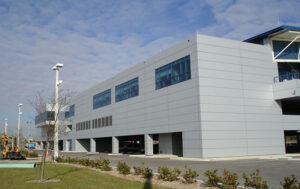
Flat panels are more economical than multi-faceted panels
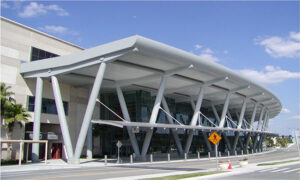
Curved panels are more expensive than flat panels
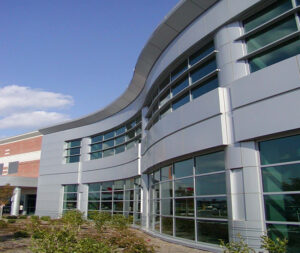
Curved and flat panels (Lay-up Panels) are the most expensive
Attachment System
MCM panels are available in a wide variety of attachment systems to meet a wide variety of design needs. These systems vary widely in cost. Several system types are outlined below and they are approximately ranked from least expensive to most expensive:
- Exposed wet seal system
- Exposed dry-gasket system
- Exposed dry-metal reveal system
- Back Ventilated Rainscreen Attachment System
- Back Ventilated Rainscreen “Hook & Pin” attachment system
Summary
Outlined below are considerations to keep in mind to make MCM Panels more economical:
- Expect to pay a significant premium for projects under 2,000 SF
- For Projects 3,000 SF and under, always use standard colors
- The larger the panel, the better the price
- Always try to maintain an average of at least 20 SF per panel
- Utilize economical modules
- Consider panel size, color and shape
- Choose the most appropriate attachment system
I hope you find this information helpful. MCM panels are often a very useful way to clad buildings and develop important feature elements. If the parameters outlined in this Blog are kept in mind they can be more economical as well.
In upcoming issues of this Blog, I will be widening the focus to include topics that are of more general interest to a wider variety of subcontractors. Some future topics will be payment terms, scheduling, and support services like bonding, lien postings, etc. Subcontractors can be a powerful force in the construction industry, but we are by nature independent types and not normally “joiners”. We need to fight that part of our nature and band together to confront common challenges. I hope to make this Blog an instrument to accomplish this challenge.
Please post your comments.
Thanks,
Ted S. Miller